


English
中文
Español
Русский
عرب
Tiếng Việt
Người Bồ Đào Nha


NEWS CENTER
India announces new import and export rules again!
Author:Dongguan VG Fasteners Co., Ltd.
Click:
Time:2022-11-18 17:43:11
Indian policymakers have reworked foreign trade policy guidelines and related banking regulations to allow export incentives for international trade settled in rupees instead of traditional dollar payments.
The policy is based on a circular issued in July by the Reserve Bank of India, India’s banking regulator.
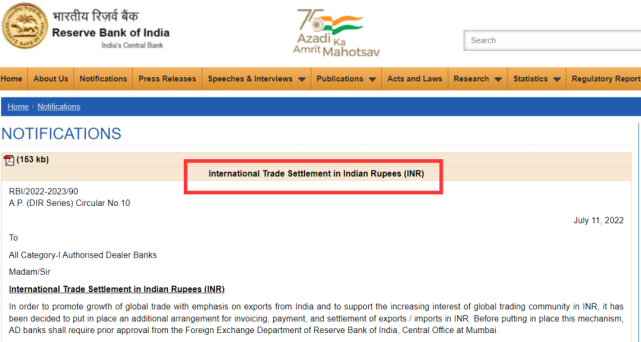
An official statement issued by India's Ministry of Commerce and Industry stated: "The Government of India has made appropriate amendments to the Foreign Trade Policy and Procedures Manual to allow international trade settlement in Indian rupees, i.e. invoicing, payment and settlement of imports and exports in Indian rupees business."
The Commerce Ministry also said: "Therefore, the performance of benefits/export obligations under the foreign trade policy has been extended to be realized in Indian rupees as per the guidelines of the Reserve Bank of India (RBI)."
It added, "Given the increased interest in the internationalisation of the Indian rupee, corresponding policy revisions have been taken to facilitate and ease international trade transactions of the Indian rupee."
While the alternative mechanism is largely aimed at overcoming payment bottlenecks on trade with Russia after the West imposed sanctions on Moscow, New Delhi is considering expanding the circulation of the rupee.
Bilateral trade between India and Russia has become a serious challenge as Russian banking institutions remain cut off from the international payment system SWIFT.
"The government now allows international trade settlements in rupees to facilitate exports. Exporters can now use our currency for trade transactions," Indian Commerce and Industry Minister Piyush Goyal said in a statement.
Shipper groups have been pressuring the government for incentives to encourage the rupee trading mechanism and the latest regulation is a response to that demand.
To that end, the Federation of Indian Export Organisations (FIEO), in an earlier call, called on the government and the RBI to consider expanding the Export Refinancing Facility for transactions settled in local currency. "This measure will be very beneficial to our small exporters as interest rates in many competing countries are much lower than in India. The double whammy is exchange rate losses as the Indian rupee remains one of the world's relatively strong currencies," FIEO said.
While trade stakeholders are optimistic about this alternative, it remains to be seen how many major banking institutions will proactively support settlement in rupees.

点击右上角
分享给朋友吧







 Long by picture save/share
0
Copyright © VG Fasteners 2021
Top
Get In Touch
Office Add.: Room 2114, Wanda plaza Business Building No.208, Dongzong Rd, Dongcheng Str, Dongguan City, Guangdong Province, china.
Factory1: Chongnan Industrial Zone, Xiqiao Town, Nanhai District, Foshan City, Guangdong Province, China
Factory2: Nantang Industrial Zone, Dongtou District, Wenzhou City, Zhejiang Province, China
Tel.:+86 769 23381372
Email:rainy.huang@vigorfasteners.com
tina.he@vigorfasteners.com
Skype:rainy41
Web:www.vgfasteners.com
点击右上角
分享给朋友吧
Please leave your contact information!
We'll offer you the best choice and solution!